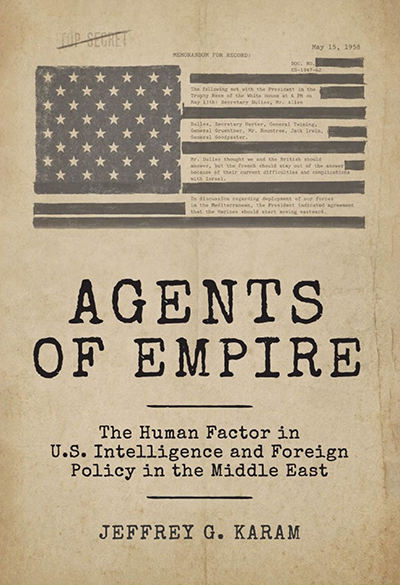
A new theory of intelligence performance that speaks to contemporary debates about intelligence failures and US foreign policy in the Middle East
Why do states fail to anticipate revolutions, coups, or other seismic ruptures, despite having intelligence officers and diplomats embedded in societies on the brink of change? While scholars have long debated the causes of surprise, failure, and misperception, existing explanations tend to emphasize information overload, bureaucratic silos, or policy bias.
In Agents of Empire, Jeffrey G. Karam takes a different approach. He foregrounds the human factor: the cognitive, relational, and contextual elements that shape how individuals in the field observe, interpret, and report on political developments abroad. Focusing on the Middle East during the revolutionary upheavals of 1958, he investigates how US intelligence officers, diplomats, and policymakers understood, or misunderstood, critical political transformations in Iraq, Lebanon, and Jordan. He argues that accuracy in political intelligence depends not only on institutional capabilities but also on the degree of openness and receptivity among both field officers and policymakers. He develops a theory of openness and receptivity to capture this dynamic.
At stake in this book is more than the accuracy of intelligence. What ultimately matters are how empires perceive disorder and political transformation, and how these perceptions shape the decisions that sustain, recalibrate, or unravel their power.
Reviews
"In this elegant study, Jeffrey G. Karam shows that US intelligence analysts were hobbled less by scanty information than by political, bureaucratic, and cognitive biases that prevented them from fully comprehending what they had gathered. Insightful, deeply researched, and carefully articulated, Karam's findings shed valuable light on today's policymaking challenges."—Salim Yaqub, author of The United States and the Middle East since 1914: Troubled Realms
"Jeffrey Karam's highly recommended Agents of Empire explores the successes and failures of American intelligence in the Cold War Middle East. Deeply researched and judiciously argued, Karam's historical case studies still reverberate today with significant contributions to security and intelligence studies as well as Middle East history."—Osamah Khalil, Syracuse University
"An important book for students and scholars of both intelligence studies and Middle East studies. It is a reminder that even in today's era of exquisite technology and artificial intelligence, the role of human beings, both as intelligence producers and intelligence recipients, remains the key to anticipating surprise and disaster."—Erik Dahl, Professor of National Security Affairs, Naval Postgraduate School
About the Author
Jeffrey G. Karam is a political scientist at the Lebanese American University and a research fellow at the Lebanese Center for Policy Studies and Freie Universität Berlin. He is the editor of The Middle East in 1958: Reimagining a Revolutionary Year.