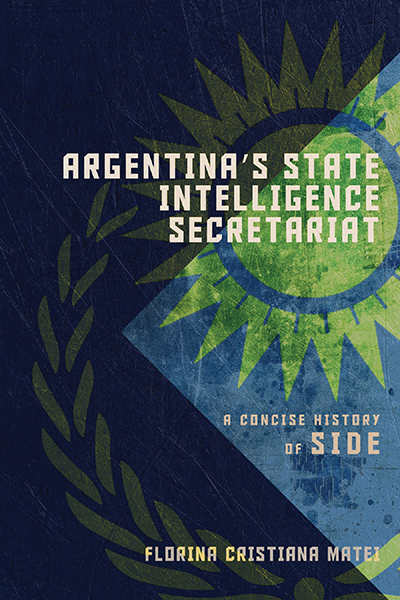
An introduction to Argentina's principal civilian intelligence agency and its complex history through dictatorships and democracy
Argentina's State Intelligence Secretariat (Secretaría de Inteligencia del Estado, SIDE) was involved in a succession of dark episodes in the country's history, including aiding or turning a blind eye to Nazi war criminals settling in Argentina and playing a role as one of the drivers of repression, torture, disappearances, and murder during the Dirty War era (1976–83).
Argentina's State Intelligence Secretariat examines the role and place of Argentina's principal intelligence service from 1956 to the present through military dictatorships and into the country's democratic era. Drawing on extensive primary sources, multilingual scholarship, media reporting, and interviews with regional experts, this concise history offers an analysis of how SIDE has interacted with political leaders, the armed forces, and other state institutions across shifting political regimes.
In addition to revealing SIDE's controversial past, Florina Cristiana Matei explores whether intelligence agencies can be democratized and held accountable after an authoritarian country's transition to democracy. The case of SIDE shows the difficulty of a complete democratic transition and holding human rights violators accountable.
For readers of intelligence and Latin American politics and history, this book offers a nuanced understanding of SIDE's institutional culture, governance, and public image, and how these traits have shifted—and at times persisted—since the country's transition to democracy.
Reviews
"Matei interprets the broad, twentieth-century history of Argentine intelligence, filling a gap in intelligence studies that contributes to a long-overdue turn from the Anglosphere to the Global South. She does a particularly nice job integrating this with the country's dirty war and the Condor alliance of the 1970s and 1980s."—James Lockhart, assistant professor, Intelligence and National Security Studies, University of Texas at El Paso
"This volume makes a significant contribution to the study of intelligence through a careful examination of Argentina's recent history. Matei places the country's intelligence evolution at the center of wider debates on security governance, state power, and democratic reform, demonstrating the analytical value of Latin American case studies for the discipline."—Carlos Solar, Senior Research Fellow in Latin American Security, Royal United Services Institute
"Latin American intelligence services are too often ignored, excepting Cuba and possibly Mexico. Matei has made a valuable contribution with her history of Argentine intelligence. It is an unpleasant historical record but one that bears examining and comprehending as a case study in struggling to control intelligence agencies."—Mark M. Lowenthal, author, Vigilance Is Not Enough: A History of United States Intelligence
"This book deconstructs the history of the iconic Argentine intelligence agency. In an engaging yet detailed way, Matei offers multiple perspectives on its evolution, set against the backdrop of the country's turbulent politics and culture—a valuable resource for scholars and students of the Southern Cone and intelligence studies alike."—Eduardo E. Estévez, independent researcher, former official in the Argentine security sector
About the Author
Florina Cristiana (Cris) Matei is a senior lecturer at the US Naval Postgraduate School. She is the coeditor of The Conduct of Intelligence in Democracies, The Handbook of Latin American and Caribbean Intelligence Cultures, and The Routledge Handbook of Media and Intelligence.