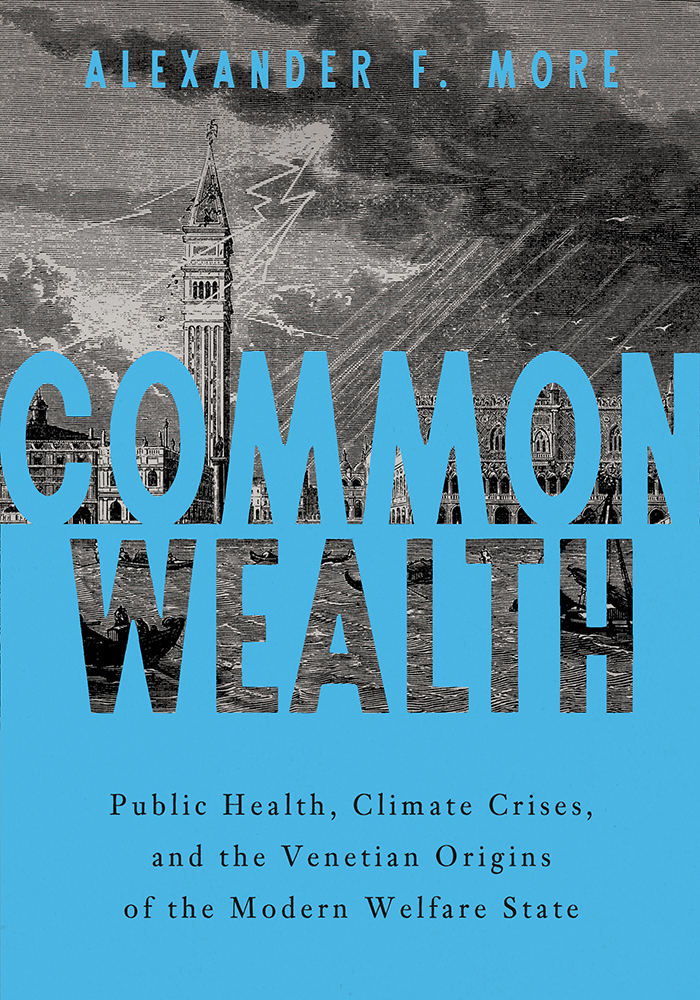
Timely lessons for today's health and climate crises rooted in one of the earliest cases of government's provision for the common good
The question of whether a government should take care of its people—preparing and investing in public health, welfare, and resilience policies—is arguably more important today than ever, as the world faces unprecedented climate and health crises.
Commonwealth's exploration of the Venetian Republic—one of the oldest and most enduring in history—establishes for the first time that this state developed welfare policies not in response to the plague, as is commonly thought, but two centuries earlier. Alexander More reveals that the lawmakers of Venice took advantage of an economic revival to provide free medical assistance for their population. The Republic also inspected and guaranteed the quality and availability of food, water, and medicine, even when sudden climatic changes caused harvests to fail and supply chains to shift.
Through original archival research in multiple languages, More shows that the welfare state of the Venetian Republic, which influenced key modern examples, took shape through deliberate efforts to work toward the common good. Readers interested in the history of medicine and public health, food security, welfare, economic history, climate science, and law will benefit from new insights into the origin and nature of commonwealth in society.
Georgetown University Press gratefully acknowledges the support of a publishing grant from Furthermore, a program of the J. M. Kaplan Fund.
Reviews
"Alex More is that rare academic with the storytelling chops to match his meticulous research. While I've filmed entire documentaries in Venice, Commonwealth has me thinking about that wondrous city in a whole new way. His book is a much-needed dose of hope for those who believe in public solutions for very big problems."—Bill Weir, CNN Chief Climate Correspondent
"Alexander More's book prompts a relevant question: If the Venetian Republic concluded eight centuries ago that profiting from human illness threatens both the health of the patient and the state itself, shouldn't twenty-first-century America examine their successful alternative—providing universal health care for our citizens?"—Paul G. Kirk, Jr., former US senator from Massachusetts, former chairman of the JFK Library Foundation Board of Directors
"At a moment when social policies are under attack, Alexander More demonstrates that public health and welfare policies supported the emergence of the first major republic in the preindustrial world. These policies did not just supplement the republic—they sustained it. They remain essential to the survival of republics today."—Louis Hyman, Dorothy Ross Professor of Political Economy in History, Johns Hopkins University
"In stunning archival detail, Alexander More documents novel health-supporting policies of the Republic of Venice, interventions in place long before the Black Death. He demonstrates that nothing less than unwavering attention to the general welfare and common good of its population ensured the stability and security of the Venetian state for more than six hundred years."—Ann G. Carmichael, emerita professor of history, Indiana University, Bloomington
"Alexander More offers a compelling evidence-driven account of where public health began. Commonwealth does a terrific job of showing us how Venice—through subsidizing food, funding hospitals, employing physicians on a salaried basis, and enforcing quarantine more than a century before the Black Death—long understood that the health of a population and the health of an economy are inseparable."—Sandro Galea, MD, DrPH, Dean & Kahn Distinguished Professor in Public Health, Bursky School of Public Health, Vice Provost for Interdisciplinary Initiatives, Washington University in St. Louis
"Only Dr. Alexander More could combine the rigor of a scientist, the archival command of a historian, and the narrative mastery of a novelist in this engaging and necessary history of the relationship between climate—both environmental and political—and public welfare. He takes the Venetian Republic as his laboratory, but his conclusions are urgent for our own moment, and our own 'commonwealth,' of America in the twenty-first century."—Katherine Howe, New York Times–bestselling and award-winning historian and novelist
"Commonwealth radically rethinks the origins of public health and welfare not in modern states, but in premodern Venice. As a historical innovator, More uses grain controls, medical provisioning, and environmental management to reveal not episodic charity but embedded responses to volatility. Welfare was core to premodern governance—a timely and compelling lesson."—Walton O. Schalick III, medical director, Central Wisconsin Center, and faculty member, University of Wisconsin–Madison
About the Author
Alexander F. More, a Harvard-trained economist, scientist, and historian, is an associate professor at the University of Massachusetts–Boston, with research appointments at Harvard University's Initiative for the Science of the Human Past, the Climate Change Institute, and the Max Planck–Harvard Research Center.