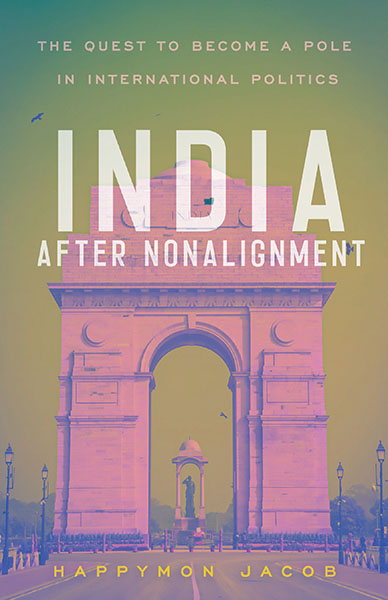
The deep roots of India's changing role in international affairs
In 1947, India's adoption of a strategy of nonalignment was primarily seen as a way to preserve the country's sovereignty and independence amid Cold War rivalry. But what if preservation was actually ambition?
India After Nonalignment traces the history and evolution of India's foreign policy to uncover a century-old aspiration: the nation's ambition to become a distinct pole––a center of power, norms, and geopolitical activity––in a multipolar world. Using a fresh conceptual framework, Jacob examines how India's old nonalignment policy, ongoing aversion to military alliances, and recent enactment of strategic autonomy have collectively been driven by this deeply rooted desire to become a consequential and unique actor in foreign affairs. He discusses India's paradigm shift from a reactive posture to a proactive role in shaping international norms and culture, the balance of power, and the future implications of these aspirations for its foreign policy behavior.
As the country's growing power and geopolitical significance make its ambitions more explicit, Jacob provides the perspective necessary for scholars, students, and other readers interested in international relations and South Asian studies to better understand how India perceives its journey in the international system.
Reviews
"India is an emerging pole in today's complex and confusing multipolar global order. There are few better analysts who can explain how India perceives that role, its obligations, and its benefits than Happymon Jacob. For those seeking to understand contemporary India on the global stage, this work is an important and timely contribution from a leading scholar."—Christopher Clary, associate professor of political science, University at Albany, State University of New York, and nonresident fellow, Stimson Center
"Professor Jacob has written a rigorous analysis of why India opted first for nonalignment and then for strategic autonomy, the costs it has borne as a consequence, and whether this will continue. Jacob argues persuasively that India sees itself and acts as a pole in international society. The clarity of argument, its empirical basis, and its realist lens make this book essential reading for those interested in understanding the trajectory of an India that is increasingly significant in Asia and a world in churn."—Shivshankar Menon, visiting professor of international relations, Ashoka University, and chair, Ashoka Centre for China Studies
"Happymon Jacob has written a fascinating and astute account of the origins and evolution of India's insistence on nonalignment as a foreign policy strategy. Tracing the root of the concept to Nehruvian and non-Nehruvian sources, he makes a thought-provoking argument—that nonalignment is the crystallization of India's long-held desire to be a 'pole' in global politics. A must read for anyone interested in (or baffled by) nonalignment and the ideological drivers of Indian foreign policy that persist to this day!"—Manjari Chatterjee Miller, professor of international relations and Munk Chair in Global India, Munk School of Global Affairs and Public Policy, University of Toronto, and senior fellow, Council on Foreign Relations
About the Author
Happymon Jacob is the founder and director of the Council for Strategic and Defence Research in New Delhi, the editor of India's World magazine, and a columnist for the Hindustan Times. He has written several books on Indian foreign affairs, including Line on Fire: Ceasefire Violations and India-Pakistan Escalation Dynamics (2019).