Fresh insights from a unique new data set inform understanding of Pakistan's strategic thinking
Is Pakistan an aggressive, revisionist state—or a deeply insecure one whose choices reflect anxiety as much as ambition? Outside observers and many scholars have assumed the former, attributing Pakistan's behavior to a strategic culture defined by hostility and risk acceptance. But this conclusion has rested on surprisingly thin evidentiary foundations, often relying on narrow samples of Pakistani sources to showcase continuity while overlooking debate, adaptation, and change.
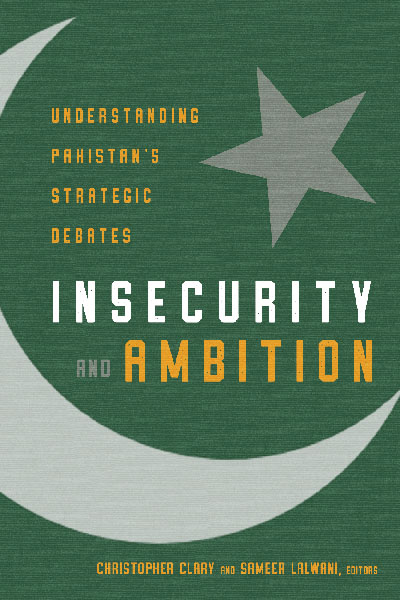
Insecurity and Ambition seeks to remedy this by using a unique new data set of Pakistan's official and semiofficial strategic literature to examine how ideas, culture, and external pressures shape how the country's strategic thinkers talk about the goals, threats, and strategies that it should adopt as it confronts an uncertain world. Edited by Christopher Clary and Sameer Lalwani, the book features insights from leading and rising scholars, ensuring a balance of local and international perspectives on the most pressing contemporary security issues.
Scholars and practitioners of South Asian security and international relations from various research traditions will gain fresh insights into how Pakistan views India, United States–Pakistan relations, Pakistan's shift toward China, Pakistan's nuclear program, the climate crisis in South Asia, and more.
Table of Contents
List of Illustrations
Foreword
Elizabeth Threlkeld
Introduction: Why Study Pakistan's Strategic Literature?
Ike Barrash, Christopher Clary, Hannah Haegeland, Eyal Hanfling, and Sameer Lalwani
1. Mythmaking and Learning in Pakistan's India Discourse
Christopher Clary
2. From Disappointment to Danger: Tracing the Trajectory of US– Pakistan Relations in Pakistani Strategic Discourse
Christopher Clary
3. Pakistan's Shift Toward China: Evidence from PakistaniStrategic Journals
S. Rashid Munir and Yunas Samad
4. Pakistan's Strategic Culture and Nuclear Choices: Analyzing the Dynamics of Continuity and Change
Beenish Pervaiz
5. Pakistan's Strategic Imagination of Civil– Military Relations
Muhammad Omar Afzaal
6. Pakistani Strategic Thought on Internal Conflict
Asfandyar Mir
7. Pakistan's Strategic Culture: Nationalism and Integration
Farhan Hanif Siddiqi
8. The Climate Crisis in South Asia: Changing Strategic Discourse Around an Emergent Threat
Ahsan I. Butt
Conclusion: Pakistan Strategic Thought Amid Enduring Crisis
Christopher Clary
Index
List of Contributors
Reviews
"This volume's contributors skillfully combine the best data ever assembled on Pakistan's strategic culture, together with their own deep knowledge of Pakistan's internal politics and external challenges, to provide a superb overview of Pakistan's strategic past, present, and future."—Steven Wilkinson, Yale University
"This is a remarkable piece of research that uses a unique compilation of Pakistani strategic writing with sophisticated mixed-methods analyses to identify crucial continuities and changes in how Pakistan's security elite understand the world. There is little like it out there; this book is a must-read."—Paul Staniland, professor of political science, University of Chicago
"The Stimson Center has long been an anchor for fresh work on Pakistan. This exciting new collection is a major contribution to scholarship on Pakistan and a demonstration of how new work on digital archives can enrich our understanding of how countries see and interpret themselves."—Alexander Evans, professor and associate dean for strategic development, London School of Economics
"The analysis traces how Pakistani views of the United States have evolved from that of an unreliable partner to an active threat to Pakistan's sovereignty and stability. By unpacking the roots of mistrust, disappointment, and resentment, the authors demystify the conspiracy theories that fuel anti-American sentiment."—Saeed Shafqat, Tamgha-e-Imtiaz, Chevalier des Palmes academiques, professor emeritus, Forman Christian College
"Ambitious and analytically sophisticated, this volume examines the external and domestic drivers of Pakistan's security while challenging common beliefs about the military and its interactions with civilian elites. Given the difficulties of researching sensitive topics in Pakistan, these essays demonstrate alternative modes of archival research using mixed methods and set a new standard for scholarship, pushing well beyond conventional sources and approaches to studying Pakistan's strategic culture."—Kavita R. Khory, Ruth Lawson Professor of Politics, Mount Holyoke College
"Drawing on a unique trove of primary sources, this volume traces how Pakistani strategic elites have understood their relationships with the United States and China at critical junctures and opens a revealing window into the narratives, preoccupations, and anxieties of a heavily securitized state."—Joshua T. White, C.V. Starr Distinguished Professor of Practice, Johns Hopkins School of Advanced International Studies
About the Author
Christopher Clary is an associate professor of political science at the University of Albany and the author of The Difficult Politics of Peace: Rivalry in Modern South Asia.
Sameer Lalwani is an adjunct professor at Georgetown University's School of Foreign Service and a nonresident senior fellow with the German Marshall Fund of the United States.