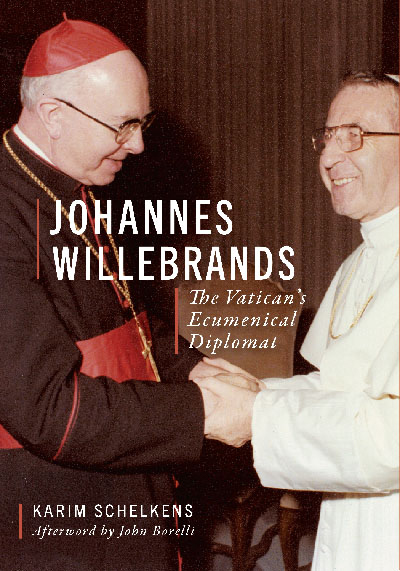
The story of a pioneering cardinal who was a key architect of the Roman Catholic Church's ecumenical and interreligious commitment
Catholicism during the twentieth century was characterized by changing Church attitudes toward other religions. At the center of these changes was Johannes Willebrands, the pioneering Dutch cardinal.
Johannes Willebrands uncovers the life of this man who led the world's largest religion to embrace dialogue and religious liberty. Drawing on newly discovered archival sources, Karim Schelkens tells the story of how Willebrands, who lived through two world wars, was moved to launch under-the-radar initiatives that helped move European Catholics beyond an attitude of condemning Protestants, Eastern Orthodox, Jews, and Muslims in the postwar years. His diplomatic role became central once these initiatives were adopted during the Second Vatican Council, leading to a surge in interreligious dialogue and worldwide changes in the relationship of the Catholic world with those outside it. Through these initiatives, Willebrands also influenced the relationship between communities on either side of the Iron Curtain.
Previously published in Dutch, this English translation of Johannes Willebrands sheds new light on what drove the pivotal changes to the Catholic Church in the Cold War era. Readers interested in political-diplomatic history, interreligious dialogue, ecumenism, Church history, the Vatican, and Catholicism will gain a new perspective on the diplomatic efforts behind this shift.
Table of Contents
Preface and Acknowledgments
West Frisian Roots
Part I From Accountant's Son to Beguinage Chaplain (1909–1940)
1 The Willebrands-Kok Family
2 Leaving Bovenkarspel
3 Among the Secular Clergy at Hageveld and Warmond
4 From Aquinas to Newman: An Intellectual U-Turn
5 Chaplain in Amsterdam
Part II The Discovery of Dialogue (1940–1962)
6 The Philosophicum in Wartime
7 Business as Usual?
8 Willebrands Sounds like Willibrord
9 From Amsterdam to Rhodes
10 An Address in Rome
Part III Beyond Euphoria (1962–1989)
11 An Ecumenical Council
12 Pope Paul VI's Man
13 Johannes Willebrands's Urbi et Orbi
14 The Netherlands' Invisible Cardinal
15 The Triumvirate Disintegrates
16 Under the Wings of a Polish Pope
17 Injury Time, Then the Berlin Wall Fell Epilogue: Life as Recollection (1989–2006)
Afterword by John Borelli
Archival Sources
Photo Gallery
Index
Reviews
"Karim Schelkens's book is the definitive biography of one of the major figures in the history of the Catholic Church in the twentieth century and its engagement in the ecumenical movement. It is also a reminder of how far Catholicism has traveled in the last hundred years."—Massimo Faggioli, Villanova University
"The publication of Schelkens's highly researched biography of Cardinal Willebrands is a most welcome development. English language readers now have an opportunity to get better acquainted with the significant contributions of this quiet and unassuming leader, armed with a profound sense of history. His dogged effort and skilled diplomacy prepared the way for the theological and institutional commitment of the Catholic Church to ecumenism and interfaith dialogue during and after the Second Vatican Council. A must-read for anyone interested in the history of Catholic ecumenical engagement."—Catherine E. Clifford, President, Catholic Theological Society of America
About the Author
Karim Schelkens is chair of the history of Christianity in late modernity at Tilburg University and an extraordinary guest professor at KU Leuven.
John Arblaster is an associate professor at the Ruusbroec Institute, of which he is currently the director. He is also a part-time visiting assistant professor in the Faculty of Theology and Religious Studies at KU Leuven.