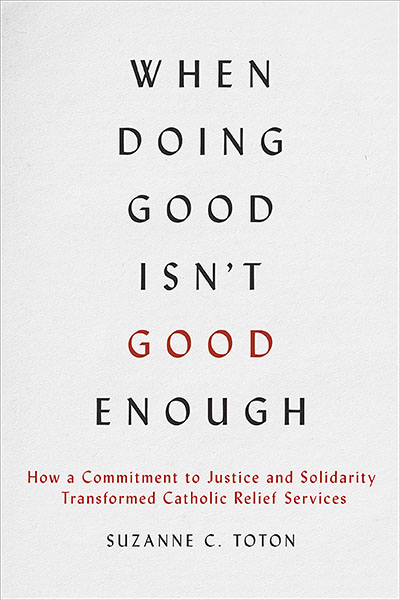
A powerful case study demonstrating how principled commitment and strategic vision can fundamentally redefine an organization's impact and purpose
In the aftermath of the Rwanda genocide, humanitarian organizations faced a profound moral reckoning. The devastating failure to address the systemic social, economic, and political inequalities created fertile ground for the mass atrocities and exposed critical gaps in traditional aid approaches. The very foundations of international relief work were challenged.
When Doing Good Isn't Good Enough offers an unprecedented look at the significance of Catholic Social Teaching, particularly its teaching on justice, for transforming Catholic Relief Services (CRS) in a time of institutional crisis after the Rwanda genocide. Toton traces the process by which CRS arrived at the decision to adopt justice as its operating lens and its methodical effort to integrate justice into every region and level of its operations. It provides a window into CRS's deep commitment to the people it serves; the challenges of implementing right relationships while working within diverse ethnic, cultural, and religious contexts; the lessons learned; and the institutional changes it catalyzed.
For organizational leaders, relief and development professionals, scholars, and people who belong to faith-based movements, this book provides a powerful case study of institutional transformation across cultures—demonstrating how principled commitment and a strategic vision can fundamentally redefine an organization's impact and purpose.
Reviews
"A brilliant account of the highly consequential transformation of Catholic Relief Services as it emerged with a bold new vision of solidarity and integral human development. Through riveting case studies illustrating key episodes in the recent life of this venerable humanitarian organization, the reader comes to appreciate how the adoption and application of a 'justice lens' inspired by Catholic social teaching thoroughly renewed the mission and self-understanding of CRS."—Thomas Massaro, SJ, McGinley Endowed Chair in Religion and Society, Fordham University
"This is a story that has been waiting to be told, and Suzanne Toton tells it extremely well. Catholic Relief Services is one of those rare organizations that, when confronted with the limitations of its practices, turned not to defensiveness, but to profound self-examination and renewal. Toton's account of these crucial years is at once sympathetic and incisive. The result is a book that has significant implications for nonprofit leadership, peace studies, theology, and more."—Todd Whitmore, associate professor of theology, codirector in Catholic social tradition, and faculty fellow, Kroc Institute for Institutional Peace Studies, University of Notre Dame
"Professor Toton has written an excellent book describing how, in the wake of the Rwandan genocide, Catholic Relief Services renewed its faith-based mission through the justice lens of Catholic social teaching. Because of this renewal of its mission, Catholic Relief Services is now better equipped to transcend the often bitter political divides within our own country to find a common path forward where all sides can support humanitarian assistance for those suffering around the world. Consistent with Jesus's parable of the Good Samaritan, this renewal of a faith-based mission through the justice lens of Catholic social teaching has also strengthened the commitment of the organization to serve all in need without regard to creed, race, or nationality."—Henry Schwalbenberg, director, Graduate Program in International Political Economy and Development, Fordham University
About the Author
Suzanne C. Toton is professor emerita of theology and religious studies at Villanova University. She is the author of World Hunger: The Responsibility of Christian Education and Justice Education—From Service to Solidarity as well as numerous articles in scholarly journals.